NIHSS Scoring Walkthrough: The 11 Items, With Original Practice Scenarios
A plain-language walk through all 11 NIH Stroke Scale items, the scoring rules people miss, and three original written scenarios to practice on — built to teach the method, not to leak copyrighted test content.
Reviewed ·
The NIH Stroke Scale is the number everyone at the bedside repeats — to the neurologist on the phone, in the thrombolytic decision, in the transfer packet. But a NIHSS is only useful if it’s scored consistently, and the scale has a handful of rules that trip up even experienced nurses. This walkthrough covers all 11 item groups and the scoring traps, then gives you three original practice scenarios to run.
A note on practice materials
The official NIHSS training images and certification scenarios are copyrighted. Everything here is written from scratch to teach the method. For real patient care and for certification, use the official certified scale and your facility’s training — not a screenshot from the internet.
The golden rule: score what you see, first try
The single most important habit: record the patient’s first response, and score the deficit — not what you think they could do. Don’t coach, don’t demonstrate repeatedly to fish for a better answer, and don’t give credit for “they would’ve gotten it.” If the patient does it, they get the points for doing it; if they don’t, they don’t. This is what makes one nurse’s 8 match the next nurse’s 8.
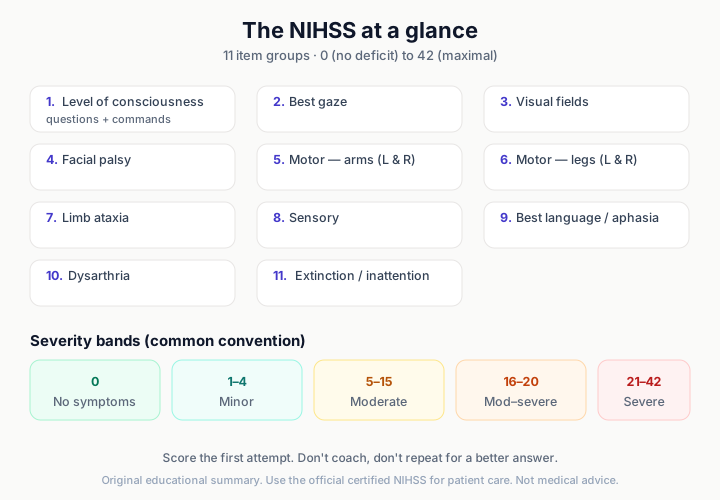
The 11 items, quickly
- Level of consciousness — three parts: overall alertness (1a), two questions (the month and their age, 1b), and two commands (open/close eyes, grip/release, 1c). Only the first answer counts, and the questions must be answered exactly right — “close” doesn’t score.
- Best gaze — horizontal eye movement. Test only horizontal.
- Visual fields — by confrontation; use finger counting or visual threat if needed.
- Facial palsy — symmetry with teeth-showing, eyebrow raise, eye closure.
- Motor, arms — each arm scored separately; 10 seconds at 90° (sitting) or 45° (supine).
- Motor, legs — each leg separately; 5 seconds at 30° supine.
- Limb ataxia — finger-to-nose and heel-to-shin; scored only if out of proportion to weakness.
- Sensory — pinprick; score for the deficit you can confirm.
- Best language — describe a scene, name objects, read sentences; this is aphasia.
- Dysarthria — clarity of speech (the articulation, not the language).
- Extinction and inattention — double simultaneous stimulation; neglect.
Aphasia vs. dysarthria — the classic mix-up
Language (item 9) is about content — can they get the right words in and out? Dysarthria (item 10) is about clarity — are the words slurred? A patient can have perfectly clear speech that’s the wrong words (aphasia), or perfectly correct words that are slurred (dysarthria). They score different items.
Scoring traps people miss
- The intubated or non-verbal patient doesn’t automatically get max points. Several items have specific rules for the untestable patient — know them (e.g., dysarthria scores 9/untestable if intubated).
- Item 1a is never “untestable.” You always assign a level of consciousness.
- Ataxia is scored absent when the limb is too weak to test — weakness already captured elsewhere shouldn’t be double-counted as ataxia.
- A prior deficit still counts. The NIHSS scores what’s present now, including old deficits; the clinical change is a separate judgment.
Three original practice scenarios
Work each one, total it, then check yourself.
Scenario A. A patient is fully alert, answers the month and their age correctly, and follows both commands. Gaze is normal, visual fields full. There is a minor right facial droop (minor paralysis). The right arm drifts down partway within 10 seconds but doesn’t hit the bed; the right leg holds. No ataxia, sensation intact, language normal, speech clear, no neglect. Points: 1a-0, 1b-0, 1c-0, gaze-0, fields-0, face-1, right arm-1, left arm-0, right leg-0, left leg-0, ataxia-0, sensory-0, language-0, dysarthria-0, extinction-0. Total = 2 (minor).
Scenario B. A patient is drowsy but rouses and answers only one question correctly; follows one of two commands. There is a partial gaze preference that overcomes with the oculocephalic maneuver, a partial (quadrant) visual field cut, and an obvious lower-face droop. The left arm falls to the bed within 10 seconds; the left leg falls within 5 seconds. Sensation is decreased on the left, and there is left-sided inattention on double stimulation. Language and speech are intact. Rough points: 1a-1, 1b-1, 1c-1, gaze-1, fields-1, face-2, left arm-3, left leg-3, sensory-1, extinction-1 (others 0). Total ≈ 15 (upper-moderate).
Scenario C. A patient is alert and oriented with normal gaze and fields, no facial or limb weakness, and normal sensation — but describes the cookie-theft scene with the wrong words and can’t name a pen or read the test sentence. Speech articulation is clear. Points concentrate in item 9. Total is driven by the aphasia (language 1–3 depending on severity), everything else 0 — a reminder that a low total can still mean a disabling, treatable stroke.
The number isn't the whole patient
A posterior-circulation stroke can be devastating and still score low on the NIHSS, which is weighted toward anterior-circulation, cortical signs. A low score never rules out a stroke worth treating — escalate on the clinical picture, not just the number.
Keep going
Once you’ve scored the deficit, the treatment decision follows — see TNK vs tPA: what stroke nurses do differently. And when you chart the exam, neuro checks: documenting them defensibly covers doing it in a way that holds up. A dedicated NIHSS practice trainer with original scenarios is on the way in our tools.
Sources
References
- NIH — Know Stroke / NIH Stroke Scale — the official scale and training
- StatPearls — NIH Stroke Scale/Score (NIHSS) — item-by-item reference
- 2026 AHA/ASA Acute Ischemic Stroke Guideline — how the score drives treatment