CCRN vs PCCN: Which Critical-Care Certification Is Right for You?
CCRN and PCCN are both AACN certifications, but they're for different patients and different units. A clear comparison of patient population, eligibility hours, exam format, and how to choose the one that matches where you actually work.
Reviewed ·

Both the CCRN and the PCCN come from AACN, both prove you know your specialty cold, and both can boost pay and mobility. The question isn’t which is “better” — it’s which one matches the patients you actually care for. Get that right and the choice is obvious.
The core difference: how sick are your patients?
Everything flows from the patient population.
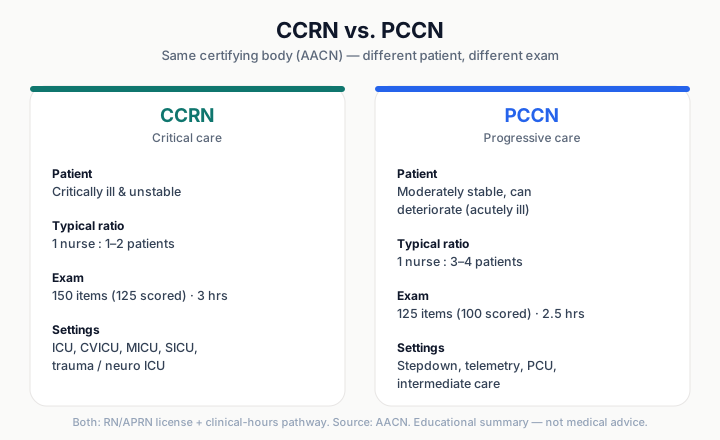
- CCRN certifies critical-care nursing — critically ill and unstable patients, typically at a 1:1 or 1:2 ratio. Think ICU, CVICU, MICU, SICU, trauma, and neuro ICU.
- PCCN certifies progressive-care nursing — patients who are acutely ill and moderately stable but at risk of deteriorating, typically at a 1:3 or 1:4 ratio. Think stepdown, telemetry, PCU, and intermediate care.
The fastest way to decide
Ask: if my patient suddenly crashes, is that the expected part of the job or the exception? If instability is the norm and your ratio is 1:1–1:2, you’re CCRN. If your patients are mostly stable-but-watchful at 1:3–1:4, you’re PCCN.
Eligibility: the clinical hours
Both certifications require an active RN or APRN license and a clinical-hours pathway. AACN offers two hour options for each:
- Two-year path: 1,750 hours in the prior two years, with 875 in the most recent year.
- Five-year path: 2,000 hours in the prior five years, with 144 in the most recent year.
The key nuance: those hours must be with the right patient population for the certification. CCRN hours must be caring for critically ill patients; PCCN hours with progressive-care patients. Working in the setting you’re certifying for is the point.
Exam format
The exams differ in length, matching the scope:
- CCRN (Adult): 150 items (125 scored + 25 unscored pretest), 3 hours.
- PCCN: 125 items (100 scored + 25 unscored pretest), 2.5 hours.
Both are built from a blueprint weighted toward clinical judgment (the AACN “Synergy Model” framing), and both are multiple-choice.
Which should you take?
- Take the CCRN if you work in an ICU-level environment with unstable, 1:1–1:2 patients.
- Take the PCCN if you work stepdown/telemetry/PCU with moderately stable, 1:3–1:4 patients.
- Moving from stepdown to ICU? Some nurses earn the PCCN first, then the CCRN after building ICU hours — but there’s no requirement to “ladder” them. Certify for where you are.
Certify for where you actually work
It’s tempting to reach for the CCRN because it sounds more prestigious, but your eligibility hours have to match the patient population — and you’ll answer questions from that world. The certification that fits your unit is the one you’ll pass and the one that means something to your employer.
Keep going
Worried about difficulty? The 2025 CCRN pass rate breaks down what the numbers really mean. Ready to prepare? How to study for the CCRN gives you a plan.
Sources
References
- AACN — Should I Apply for the CCRN or PCCN Exam? — AACN's own comparison and eligibility
- AACN — CCRN (Adult) certification — exam format and hours