Neuro Checks: Documenting Them Defensibly
A neuro check is only as good as the record it leaves. How to chart level of consciousness, pupils, motor, speech, and vitals so the trend is obvious, the change is caught, and the documentation holds up — with the specific phrasing that beats 'neuro checks stable.'
Reviewed ·
The whole point of a neuro check is to catch a change early — a widening pupil, a new drift, a subtle slur. But a change is only visible if the last check was recorded clearly enough to compare against. Vague charting (“neuro checks stable,” “neuro intact”) is where deterioration hides, and it’s exactly the kind of note that reads badly in hindsight. Here’s how to document a neuro check so the trend is obvious and the record protects both the patient and you.
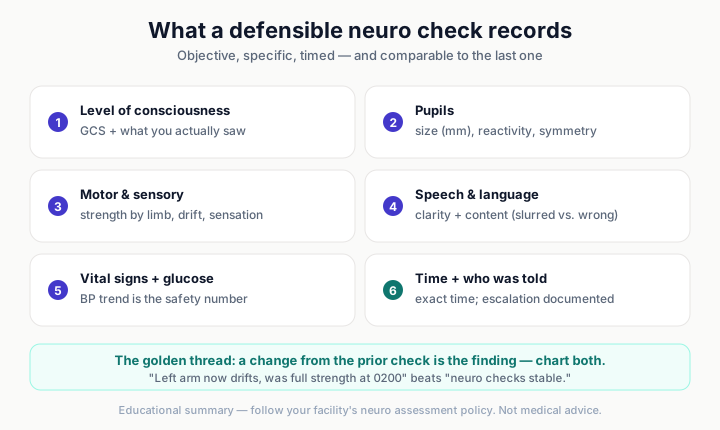
The principle: objective, specific, and comparable
Good neuro documentation has three properties. It’s objective (what you observed, not your conclusion), specific (numbers and sides, not adjectives), and comparable (structured the same way every time so a change jumps out). “Patient looks worse” fails all three. “Left arm now drifts to the bed in 10 seconds; held at 90° on the 0200 check” passes all three — and tells the next clinician exactly what changed and when.
What each component should actually say
Level of consciousness. Chart the Glasgow Coma Scale and what you saw. “GCS 14 (E4 V4 M6) — drowsy, oriented to person and place but not date, follows commands” is worth more than “GCS 14” alone, because the next nurse can reproduce it.
Pupils. Size in millimeters, reactivity, and symmetry: “PERRL 3 mm → 2 mm briskly, equal.” A new inequality or a sluggish pupil is a red flag — document the exact size, because “pupils okay” can’t be trended.
Motor and sensory. Strength graded by limb, drift noted, sensation checked. “Right hand grip 3/5, left 5/5; right pronator drift present” localizes the problem. Always chart by side.
Speech and language. Distinguish clarity from content — slurred speech (dysarthria) and wrong words (aphasia) are different findings. “Speech clear but naming impaired — called a watch a ‘clock’” is specific; “speech off” is not.
Vital signs and glucose. The blood pressure trend is a safety number, especially post-thrombolytic (keep below 180/105 for 24 hours) or with raised ICP. Chart the trend, not just the point.
The phrase that does the work
When something changes, write the change and the baseline in the same breath: “Left arm now drifts, was full strength at 0200.” That one sentence records the finding, timestamps it, and proves you were comparing to the prior check. It’s the difference between catching deterioration and documenting that you caught it.
Timing and escalation are part of the record
A neuro check note isn’t finished until it answers when and who:
- Exact time, not “this morning.” Neuro changes are timed events, and the clock drives treatment windows.
- What you did with a change — who you notified, when, and what was ordered. “Dr. ___ notified at 0315 of new right arm drift and GCS drop to 12; stat CT ordered” closes the loop.
- Read-backs and orders captured, so the chain from finding to action is unbroken.
Silence is not reassuring in a chart
If a check is due and not documented, the record reads as though the patient wasn’t assessed — even if you were in the room. On a stroke or neuro-ICU patient, a gap in the neuro flowsheet is the thing a reviewer notices first. Chart every scheduled check, and chart the escalation when the picture changes.
A quick before/after
Weak: “Neuro checks stable overnight. Pupils okay. Moving all extremities.”
Defensible: “0200: GCS 15, PERRL 3 mm brisk equal, moves all four 5/5, speech clear, BP 148/82. 0400: GCS 14 (drowsy, oriented ×2), right pupil 4 mm sluggish / left 3 mm brisk, right arm drift to bed (was 5/5 at 0200), speech clear, BP 176/94. Dr. ___ notified 0405; stat CT ordered.”
The second version caught a deteriorating patient. The first version described the same two hours and caught nothing.
Keep going
The exam behind the charting: NIHSS scoring walkthrough. And if you’re new to this environment, new nurse on a stroke unit: the first 90 days covers building the assessment rhythm that makes good documentation automatic.
Sources
References
- AANN — Clinical Practice Guidelines (neuroscience nursing) — standards for neuro assessment and documentation
- StatPearls — Glasgow Coma Scale — GCS scoring reference
- 2026 AHA/ASA Acute Ischemic Stroke Guideline — post-thrombolytic monitoring parameters