ABG Interpretation Made Easy: The Tic-Tac-Toe Method (With Practice)
Learn to interpret any arterial blood gas in four steps using the tic-tac-toe method and the ROME mnemonic — normal values, acidosis vs. alkalosis, compensation, the anion gap, and worked practice examples for nurses and nursing students.

Arterial blood gases scare a lot of nurses, and they shouldn’t. Once you stop trying to reason your way through the chemistry in the moment and instead use a simple, repeatable system, you can call any ABG in under a minute. The tic-tac-toe method is that system. By the end of this guide you’ll be able to look at a pH, a PaCO₂, and an HCO₃⁻, and confidently say whether your patient is in respiratory or metabolic acidosis or alkalosis — and whether they’re compensating.
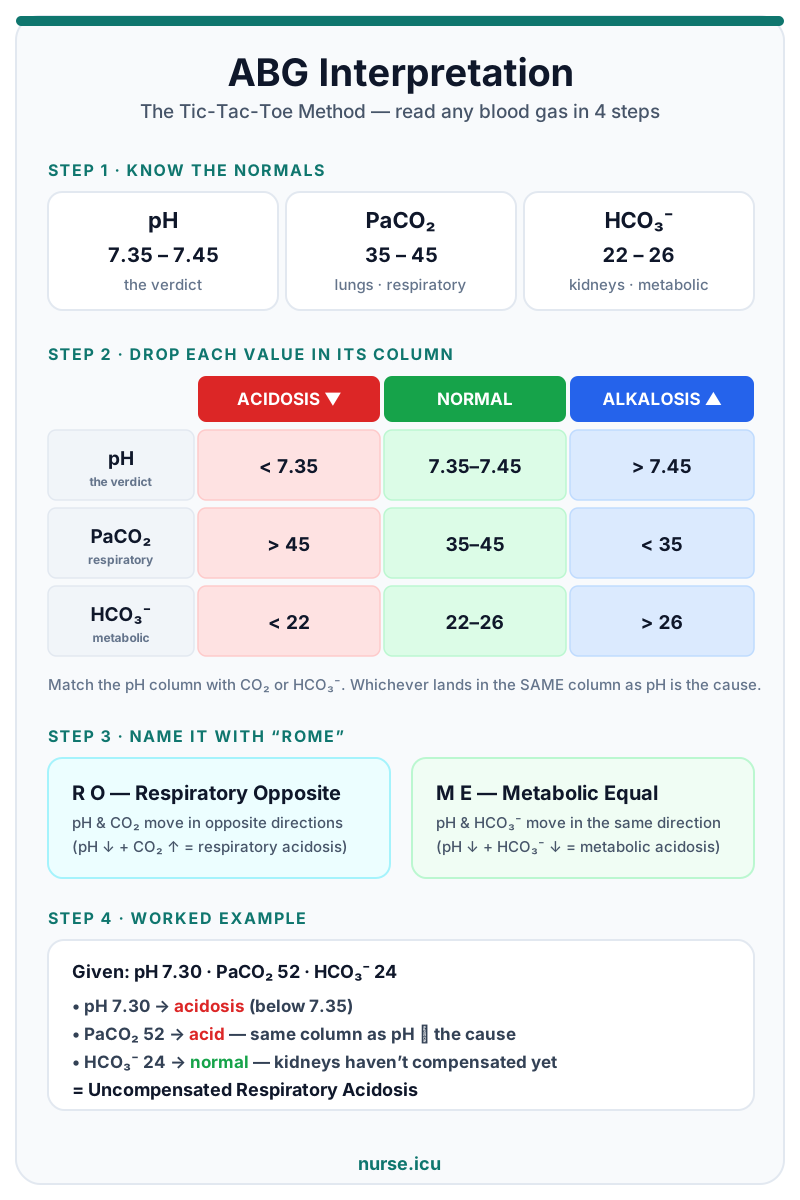
Here’s the whole method on one page. Save it, pin it, screenshot it for your clinical — then read on for how each step works.
Step 1 — Know the three numbers
You only need three values to name an acid-base disorder. Memorize these normal ranges cold:
| Value | Normal range | What it tells you |
|---|---|---|
| pH | 7.35 – 7.45 | The verdict — acidotic, normal, or alkalotic |
| PaCO₂ | 35 – 45 mmHg | The respiratory side (lungs) |
| HCO₃⁻ | 22 – 26 mEq/L | The metabolic side (kidneys) |
The mental model that makes everything else click: CO₂ is an acid, bicarb is a base. Your lungs control CO₂ (blow it off or hold it in), and your kidneys control bicarb (dump it or retain it). So every acid-base problem is either a lung problem (respiratory) or a kidney/metabolism problem (metabolic) — and the body’s other system tries to bail it out. That rescue attempt is called compensation, and we’ll get there.
Why CO₂ looks 'backwards'
PaCO₂ moves opposite to pH. A high CO₂ makes blood more acidic (lower pH), because CO₂ combines with water to form carbonic acid. That’s the one counterintuitive piece — everything else lines up the way you’d expect.
Step 2 — Drop each value into its column
Picture three columns: Acidosis on the left, Normal in the middle, Alkalosis on the right. Take each of your three numbers and place it in the column where it belongs:
- pH — below 7.35 goes in Acidosis, above 7.45 goes in Alkalosis.
- PaCO₂ — remember it’s backwards: above 45 is acidic (Acidosis column), below 35 is alkalotic.
- HCO₃⁻ — behaves normally: below 22 is acidic, above 26 is alkalotic.
Now read the board. The pH tells you the overall state — if it’s in the acidosis column, your patient is acidotic, full stop. Then you find the cause: whichever value — CO₂ or HCO₃⁻ — landed in the same column as the pH is the culprit. If that value is CO₂, it’s respiratory. If it’s HCO₃⁻, it’s metabolic.
That single alignment step is the entire diagnosis. Four disorders fall out of it:
| Disorder | pH | Primary value |
|---|---|---|
| Respiratory acidosis | low (below 7.35) | PaCO₂ high (above 45) |
| Respiratory alkalosis | high (above 7.45) | PaCO₂ low (below 35) |
| Metabolic acidosis | low (below 7.35) | HCO₃⁻ low (below 22) |
| Metabolic alkalosis | high (above 7.45) | HCO₃⁻ high (above 26) |
Step 3 — Sanity-check with ROME
If you ever blank on which direction things should move, the ROME mnemonic settles it:
- Respiratory Opposite — in respiratory problems, pH and CO₂ move in opposite directions (pH down, CO₂ up = respiratory acidosis).
- Metabolic Equal — in metabolic problems, pH and HCO₃⁻ move in the same direction (pH down, HCO₃⁻ down = metabolic acidosis).
ROME is just a cross-check, but it catches the classic mistake of mislabeling the respiratory cases because of that backwards CO₂.
Step 4 — Is it compensated?
Once you’ve named the disorder, ask one more question: is the other system trying to fix it? Look at whichever value wasn’t the cause.
- Uncompensated — the other value is still normal. The body hasn’t kicked in yet. (Example: respiratory acidosis with a normal HCO₃⁻.)
- Partially compensated — the other value has moved out of range in the correcting direction, but the pH is still abnormal. Help is on the way but hasn’t arrived.
- Fully (completely) compensated — both CO₂ and HCO₃⁻ are abnormal and the pH has returned to normal (7.35–7.45). To find the primary problem here, split the normal range at 7.40: if pH sits on the acidic side (7.35–7.39), the acidotic process is primary; if it’s on the alkalotic side (7.41–7.45), the alkalotic process is primary.
Read the patient, not just the gas
A “compensated” gas doesn’t mean a stable patient. Compensation is the body working hard to hold the line — always interpret the ABG alongside the PaO₂, the SpO₂, the trend, and how your patient actually looks. The same numbers can mean very different things in a stable post-op patient versus one crashing in front of you.
Worked examples
Example 1 — pH 7.30, PaCO₂ 52, HCO₃⁻ 24 pH is acidic. CO₂ is high (acidic) → same column as pH, so it’s the cause → respiratory. HCO₃⁻ is normal → not compensating yet. Uncompensated respiratory acidosis. (Think: COPD exacerbation, oversedation, hypoventilation.)
Example 2 — pH 7.50, PaCO₂ 30, HCO₃⁻ 23 pH is alkalotic. CO₂ is low (alkalotic) → matches pH → respiratory. HCO₃⁻ normal. Uncompensated respiratory alkalosis. (Think: anxiety, hyperventilation, pain, early sepsis.)
Example 3 — pH 7.29, PaCO₂ 34, HCO₃⁻ 16 pH is acidic. HCO₃⁻ is low (acidic) → matches pH → metabolic. CO₂ is slightly low (below 35), moving in the alkalotic direction to help, but pH is still abnormal. Partially compensated metabolic acidosis. (Think: DKA, lactic acidosis, diarrhea.)
Example 4 — pH 7.37, PaCO₂ 58, HCO₃⁻ 34 pH is normal — but both CO₂ and HCO₃⁻ are abnormal, so the body has fully compensated. pH 7.37 sits on the acidic side of 7.40, and the high CO₂ is the acidic driver → fully compensated respiratory acidosis. (Think: chronic CO₂ retainer whose kidneys have caught up.)
60-second routine
- pH — acidosis or alkalosis? 2. Which value (CO₂ or HCO₃⁻) matches the pH’s direction? That’s your cause and tells you respiratory vs. metabolic. 3. Is the other value normal (uncompensated), abnormal with a bad pH (partial), or abnormal with a normal pH (full)? Done.
Beyond the basics: the anion gap
The tic-tac-toe method tells you that there’s a metabolic acidosis — it doesn’t tell you why. That’s the anion gap’s job. It estimates the acids in the blood that the basic panel doesn’t measure directly:
Anion gap = Na⁺ − (Cl⁻ + HCO₃⁻), normally about 8–12 mEq/L.
A metabolic acidosis then splits into two families:
- High anion gap (above 12) — acid is being added to the blood. The classic memory aid is MUDPILES: Methanol, Uremia, DKA, Propylene glycol, Iron/Isoniazid, Lactic acidosis, Ethylene glycol, Salicylates. On most units it comes down to lactate (shock, sepsis) or ketones (DKA).
- Normal anion gap (12 or below) — bicarbonate is being lost and chloride rises to fill the space (hyperchloremic). Think diarrhea or renal tubular acidosis.
Worked example. Na⁺ 138, Cl⁻ 100, HCO₃⁻ 12 → gap = 138 − (100 + 12) = 26. Wide open — go hunting for lactate or ketones.
Why albumin matters
Here’s the catch that bites people in the ICU: albumin is the single largest unmeasured anion in the blood. When albumin is low — common in critically ill, septic, or malnourished patients — the measured gap falls, and a real high-gap acidosis can hide inside a number that looks normal. So you correct for it:
Corrected gap = measured gap + 2.5 × (4.0 − albumin in g/dL)
Worked example. A measured gap of 10 looks fine — but the albumin is 2.0 g/dL. Corrected gap = 10 + 2.5 × (4.0 − 2.0) = 15. That’s a high-gap acidosis you’d otherwise have walked right past. This is exactly why the calculator asks for albumin.
One step further
Once a high-gap acidosis is confirmed, the delta ratio — (gap − 12) ÷ (24 − HCO₃⁻) — flags whether a second metabolic disorder is riding along with it. The calculator works it out automatically when you enter the electrolytes.
The ABG analyzer
Now put it together. Enter the three core values for the acid-base call; add sodium, chloride, and albumin — explained above — when you want the anion gap too. (It also lives standalone at /tools/abg-interpreter.)
ABG Analyzer
enter the 3 core valuesAdd electrolytes for the anion gap (optional)
Optional. Filling these in adds the anion gap, the albumin-corrected gap, and the delta ratio (see the anion gap section above for what they mean).
Real-world ABG patterns and their causes
These are the patterns you’ll actually see on shift. Run any of them through the analyzer above to check yourself.
| pH | PaCO₂ | HCO₃⁻ | Interpretation | Common causes |
|---|---|---|---|---|
| 7.28 | 60 | 26 | Respiratory acidosis, acute (uncompensated) | COPD exacerbation, opioid or sedative overdose, hypoventilation |
| 7.34 | 65 | 34 | Respiratory acidosis, chronic (compensated) | Long-standing COPD / CO₂ retainer |
| 7.52 | 28 | 22 | Respiratory alkalosis, acute | Anxiety or hyperventilation, pain, early sepsis, PE, high altitude |
| 7.10 | 24 | 8 | Metabolic acidosis (high gap), respiratory compensation | DKA, lactic acidosis from shock/sepsis, toxic ingestion |
| 7.30 | 34 | 16 | Metabolic acidosis, partially compensated | Diarrhea, kidney failure, early DKA |
| 7.55 | 48 | 40 | Metabolic alkalosis, partially compensated | Vomiting or NG suction, diuretics, hypokalemia |
| 7.09 | 70 | 20 | Mixed respiratory & metabolic acidosis | Cardiopulmonary arrest, severe sepsis with respiratory failure |
| 7.58 | 26 | 30 | Mixed respiratory & metabolic alkalosis | Vomiting plus hyperventilation (e.g., liver failure, pregnancy) |
| 7.37 | 58 | 33 | Fully compensated respiratory acidosis | Chronic CO₂ retainer whose kidneys have caught up |
| 7.41 | 40 | 25 | Normal ABG | — |
Common mistakes to avoid
- Forgetting CO₂ is inverse. High CO₂ = acidosis, not alkalosis. This trips up more people than anything else.
- Calling a normal pH “no problem.” A normal pH with two abnormal values is full compensation, not a normal gas.
- Ignoring oxygenation. The tic-tac-toe method interprets acid-base status; it doesn’t assess oxygenation. Always glance at the PaO₂ (normal ~80–100 mmHg) and SaO₂ (95–100%) separately.
- Skipping the anion gap. Any time you find a metabolic acidosis, calculate the gap — it’s often the fastest route to the underlying cause.
- Interpreting in a vacuum. The story — COPD, DKA, sepsis, vomiting, salicylate overdose — usually tells you what to expect before you finish the math.
Keep going
Want the analyzer without the lesson? It has its own page at ABG Interpreter — bookmark it for shift. And if you’re studying for boards, acid-base shows up constantly on the NCLEX: the study hub is where our free practice questions are landing.
Sources
Authoritative references
- StatPearls — Arterial Blood Gas (NCBI Bookshelf) — peer-reviewed overview of ABG analysis
- MSD Manual — Acid-Base Disorders — professional reference
- American Thoracic Society — Patient resources — respiratory background