New Nurse on a Stroke Unit: The First 90 Days
A realistic, phase-by-phase guide to your first three months on a stroke or neuro unit — what to master first, what can wait, and how to build the assessment instincts that make the rest click. Written for new grads and nurses transferring in.
Reviewed ·

Stroke and neuro units feel fast and high-stakes when you start, because they are — time-critical treatment, subtle assessments that change fast, and a lot of protocol. The good news: nobody expects you to hold all of it at once, and the skills stack in a sensible order. Here’s a realistic map of the first 90 days, so you know what to put your energy into now and what can wait.
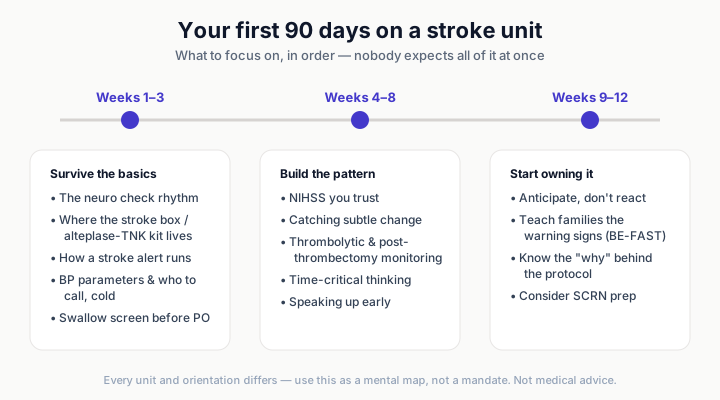
Weeks 1–3: survive the basics
Your only goals right now are safety and rhythm. Focus on:
- The neuro check rhythm. Learn to do a clean, repeatable neuro assessment and chart it so a change is obvious. This is the skill everything else rests on. (Our neuro checks documentation guide is built for exactly this.)
- Where the time-critical things live. The stroke box, the thrombolytic kit, the code cart, the CT pathway. You don’t want to be finding things during a stroke alert.
- How a stroke alert actually runs on your unit — who does what, and where you fit. Watch a few before you run one.
- Blood pressure parameters and escalation, cold. Know the post-thrombolytic target (below 180/105 for 24 hours) and exactly who you call for what, without looking it up.
- Swallow screen before anything by mouth. Make it reflex — it prevents aspiration and it’s a quality measure.
Ask the 'where' and 'who' questions early
In the first weeks, the most valuable questions aren’t clinical — they’re logistical. “Where’s the ___?” and “Who do I call for ___?” Getting those automatic frees up all your attention for the patient when it counts.
Weeks 4–8: build the pattern
Now you start turning tasks into judgment:
- An NIHSS you trust. Score enough of them that the number is consistent and quick. (The NIHSS walkthrough has original practice scenarios.)
- Catching subtle change. The difference between a stable patient and an early bleed is often small — a new drift, a slightly bigger pupil, a subtle slur. You’re training your eye to notice before the obvious decline.
- Thrombolytic and post-thrombectomy monitoring as routine, not a scramble. Know what you’re watching for and why.
- Time-critical thinking. On a stroke unit, “I’ll check on it after I finish this” sometimes isn’t safe. You’re learning which findings stop everything.
- Speaking up early. The best neuro nurses escalate on a hunch and are right often enough that nobody minds when they’re not. Build that voice now.
Weeks 9–12: start owning it
By the end of the first three months, the shift is from reacting to anticipating:
- Anticipate instead of react. You start to see where a patient is heading and get ahead of it.
- Teach families. BE-FAST (Balance, Eyes, Face, Arm, Speech, Time), what the recovery road looks like, why the monitoring matters. Teaching is also how you find out what you truly understand.
- Learn the “why” behind the protocol. Not just what the BP parameter is, but why it prevents bleeding. The reasoning is what lets you handle the situation the protocol didn’t anticipate.
- Consider certification. You don’t need it yet, but starting to think toward the SCRN (Stroke Certified Registered Nurse) gives your learning a spine. Our SCRN question bank is made for this exact audience.
Two things that trip up new neuro nurses
First, don’t let a low NIHSS lull you — posterior strokes can be devastating and score low. Second, the quiet, drowsy patient can be the sick one — a dropping level of consciousness is a change, not a patient who’s “finally resting.” When in doubt, assess and escalate.
The honest reassurance
Everyone on your unit was new to neuro once, and the learning curve is real but finite. If you master the neuro check, respect the clock, and speak up early, the rest fills in. Ninety days in, you won’t know everything — but you’ll know what you’re looking at, and that’s the whole job.
Keep going
Build the core skills: neuro checks: documenting them defensibly and the NIHSS scoring walkthrough. When you’re ready to study toward certification, the SCRN bank is where to start.
Sources
References
- AANN — Career development & neuroscience nursing resources — professional organization for neuro nurses
- AHA/ASA — BE-FAST stroke warning signs — patient/family education
- ABNN — SCRN certification — the stroke-nurse certification