IV Drip Rates: The Two Formulas, and How Not to Panic
Gravity infusions need drops per minute; pumps need millilitres per hour. Two formulas, one thing you have to look up on the tubing packet, and a way of laying the maths out that survives being interrupted.
Reviewed ·
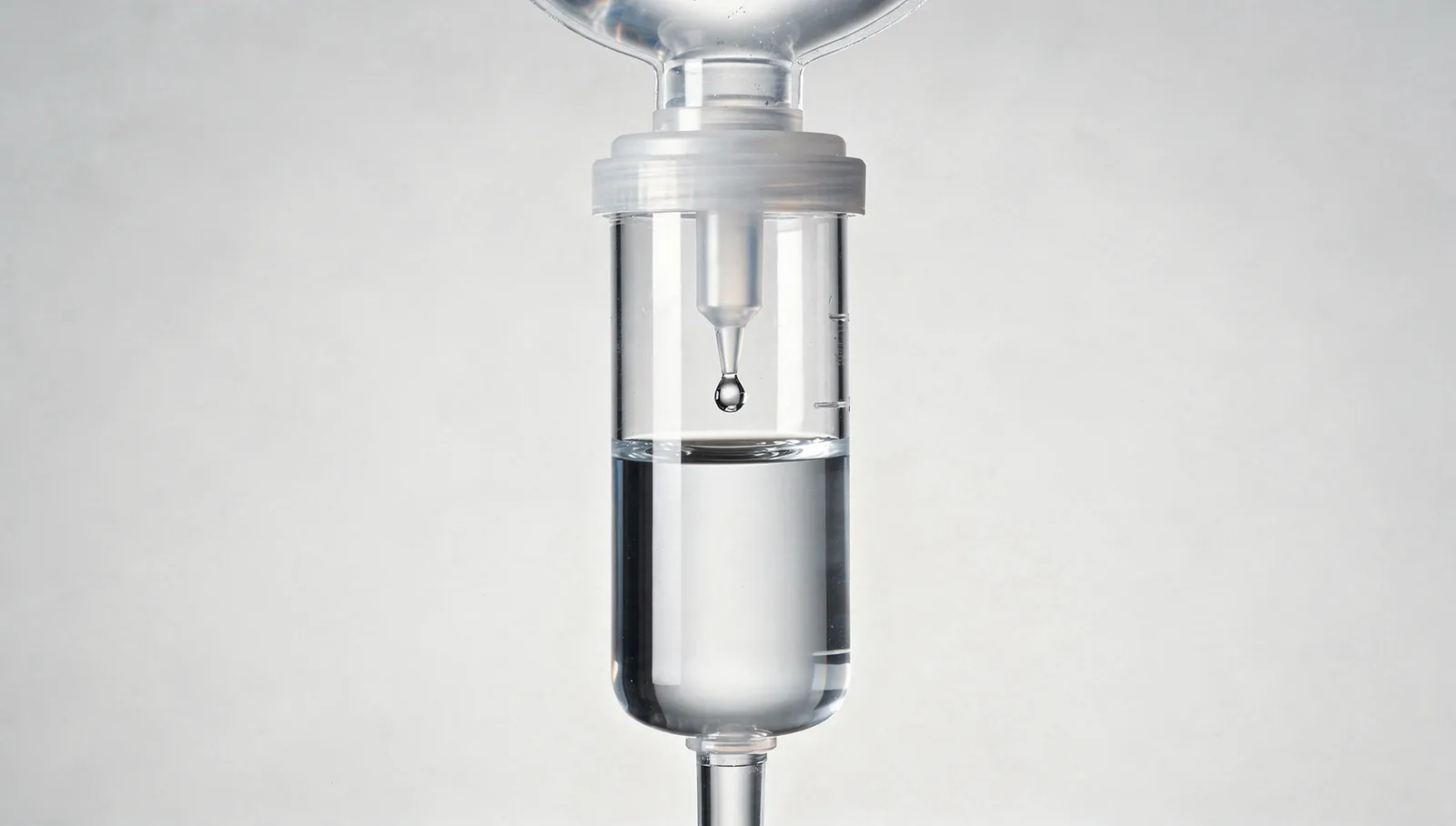
Drip rate questions are a reliable source of dread in nursing school, and the dread is mostly unearned. There are two formulas. Which one you need is decided by a single question — is this on a pump, or running by gravity? — and almost every wrong answer comes from an avoidable slip rather than from not knowing the maths.
Question one: pump or gravity?
On a pump, you’re programming millilitres per hour. The pump handles the drops.
By gravity, you’re counting drops per minute in the chamber and adjusting the roller clamp.
Get that straight before you write anything down. Solving beautifully in the wrong unit is the most common way to get these wrong.
Pumps: mL/hr
Total volume divided by total time in hours.
mL/hr = volume (mL) ÷ time (hr)
1,000 mL over 8 hours is 125 mL/hr. That’s the whole thing.
The trap is time given in minutes. 250 mL over 90 minutes isn’t 250 ÷ 90 — convert first: 90 minutes is 1.5 hours, so 250 ÷ 1.5 ≈ 167 mL/hr.
Gravity: drops per minute
gtt/min = ( volume in mL × drop factor ) ÷ time in minutes
The drop factor is how many drops that particular tubing delivers per millilitre. You can’t derive it and you can’t assume it — it’s printed on the tubing packet, and it’s the one number in this calculation that comes from the physical world rather than the question.
| Tubing | Drop factor |
|---|---|
| Macrodrip | 10, 15, or 20 gtt/mL |
| Microdrip | 60 gtt/mL |
Worked example: 1,000 mL over 8 hours, with 15 gtt/mL tubing.
- Convert the time: 8 hours = 480 minutes
- Apply it: (1,000 × 15) ÷ 480 = 15,000 ÷ 480 = 31.25
- Round to whole drops: 31 gtt/min — you cannot count a quarter of a drop
Microdrip has a shortcut worth knowing
With 60 gtt/mL tubing, the drop factor and the minutes-per-hour cancel out — so gtt/min equals mL/hr. Running 80 mL/hr on microdrip? That’s 80 gtt/min. It’s a genuinely useful sanity check, and a fast way to spot an answer that’s badly off.
Where the marks and the errors actually go
Not on the arithmetic. On these:
- Units not converted. Hours where the formula wants minutes is the single most common error. Convert as step one, every time.
- Drop factor assumed. Twenty and sixty produce wildly different rates. Read the packet.
- Rounding too early. Carry the decimals through and round once, at the end.
- Rounding drops the wrong way. Drops are whole numbers. Millilitres per hour on a pump may take a decimal depending on the device.
Sanity-check the magnitude before you touch the clamp
Ask whether the answer is plausible. A maintenance fluid running at 800 mL/hr, or an antibiotic at 3 gtt/min, should stop you regardless of what the paper says. Most catastrophic infusion errors are order-of-magnitude errors — a decimal in the wrong place — and they’re caught by asking “does that look like a normal rate?” rather than by re-checking the sum.
Lay it out so it survives an interruption
Write the calculation down rather than doing it in your head, and write it the same way every time: what you’re given, what you’re solving for, the conversion, then the arithmetic. Cancel units as you go — if the units don’t cancel to gtt/min, the setup is wrong and no amount of correct arithmetic will save it.
This isn’t pedantry. You will be interrupted partway through, and a written line you can pick back up is the difference between resuming and starting over from a half-remembered number.
The short version
- Pump or gravity — decide first
- Pump: mL ÷ hours
- Gravity: (mL × drop factor) ÷ minutes
- Drop factor comes off the packet
- Convert units first, round once at the end, and check the answer looks sane
Try it
Run the numbers with the IV drip rate calculator — useful for checking your own working while the method is still bedding in.
Keep going
For the other calculation that runs on height and weight, BMI vs BSA. Studying more broadly? ABG interpretation: the tic-tac-toe method takes the same step-by-step approach.
Sources
References
- ISMP — Institute for Safe Medication Practices — infusion error patterns and safe practice guidance
- StatPearls — Intravenous Fluid Therapy — IV therapy fundamentals