Malignant Hyperthermia: The First Five Minutes
The name is actively misleading — by the time there's a fever, you're late. The earliest reliable sign is a rising end-tidal CO2 that won't come down, and the response is dantrolene, fast, by everyone in the room at once.
Reviewed ·
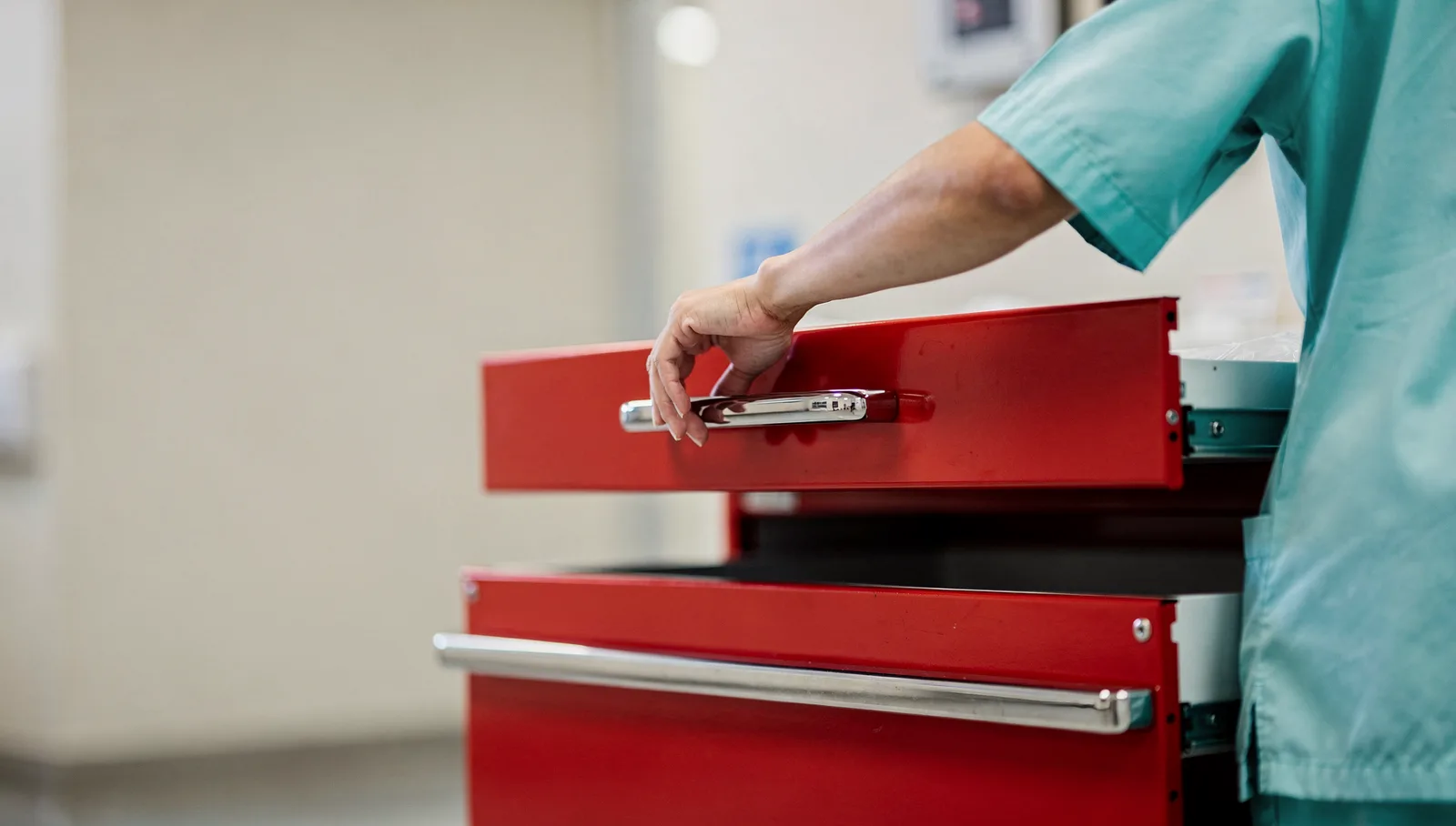
Malignant hyperthermia is rare enough that most nurses will never see one, and fast enough that the people who do see one remember it for the rest of their careers. It’s a pharmacogenetic reaction — a susceptible patient meets a triggering agent, skeletal muscle calcium regulation fails, and metabolism runs away.
The whole reason it’s survivable now is dantrolene given early. So the only thing that really matters is recognising it early, and the name gets in the way of that.
Fever is a late sign
The temperature rise the condition is named after arrives after the metabolic crisis is well underway. Waiting for it is how the diagnosis gets missed. The earliest and most sensitive sign is an unexplained, rising end-tidal CO2 that doesn’t respond to increased ventilation.
The triggers
Two categories, and they’re specific:
- Volatile inhaled anaesthetics — sevoflurane, desflurane, isoflurane, halothane
- Succinylcholine, the depolarising neuromuscular blocker
Local anaesthetics, nitrous oxide, propofol, opioids, benzodiazepines and non-depolarising blockers are not triggers. A known-susceptible patient can have a safe anaesthetic — it’s built from the non-triggering list.
Susceptibility is inherited, usually through a ryanodine receptor variant, so family history is a real screening question, not a formality. A relative who “had a problem with anaesthesia” deserves following up before the case, not after.
What you’ll actually notice
Roughly in the order they tend to appear:
- Rising end-tidal CO2 that climbs despite increasing minute ventilation — the single most useful early sign
- Unexplained tachycardia, often the first thing anyone comments on
- Masseter spasm after succinylcholine — a jaw that won’t open
- Generalised muscle rigidity, including in a patient who has been given a paralytic
- Tachypnoea in a spontaneously breathing patient; mottling, sweating, unstable blood pressure
- Hyperthermia — often sharply rising, and again, late
- Dark urine, from rhabdomyolysis, later still
The response
MH is managed by the whole room simultaneously, not sequentially. It is genuinely an all-hands event, and the single most useful thing to know is where the MH cart is before you need it.
- Stop the triggering agents. Halt volatile anaesthetic and succinylcholine immediately.
- Call for help and declare it. Say the words “malignant hyperthermia” — it mobilises a specific, rehearsed response.
- Hyperventilate with 100% oxygen at high flows to blow off the CO2 load.
- Give dantrolene. The initial dose is 2.5 mg/kg IV, repeated as needed until the episode is controlled — sometimes to a substantially higher cumulative dose. Reconstituting it is labour-intensive with the older formulation, which is exactly why several people are needed at once.
- Cool the patient — cold IV fluids, surface cooling, cooling the cavity if it’s open. Stop when the temperature approaches normal so you don’t overshoot.
- Treat the metabolic consequences — hyperkalaemia, acidosis, and arrhythmias. Calcium channel blockers are avoided with dantrolene.
- Monitor and keep monitoring. Core temperature, ECG, blood gases, potassium, creatine kinase, coagulation, and urine output — rhabdomyolysis threatens the kidneys and the risk continues well after the acute event.
Know two things before your next shift
Where the MH cart lives, and what the dantrolene preparation on it requires. Those two facts, known in advance, are worth more than anything you can look up during the event — and the second one determines how many pairs of hands the room is going to need.
Afterwards
The patient goes to intensive care and is watched for recrudescence, which can occur hours later. The episode should be reported to the relevant MH registry, and the patient and their family need to be told clearly — this is inherited information that matters to blood relatives who may never have had an anaesthetic yet.
The bottom line
Don’t wait for the temperature. An end-tidal CO2 that keeps climbing when it shouldn’t, in a patient who has had a volatile agent or succinylcholine, is the moment to say the words out loud.
Keep going
For recognising deterioration in the ward setting, early warning scores.
Sources
References
- MHAUS — Malignant Hyperthermia Association of the United States — the standard treatment protocol and the MH hotline
- AORN — Association of periOperative Registered Nurses — perioperative nursing standards
- StatPearls — Malignant Hyperthermia — pathophysiology and management